
1 of 26 Strategy Revelations for 2026
I don’t know about you, but I love the idea of setting New Year’s Resolutions.
And yet the reality of actually changing old habits or starting new ones is always harder than it seems, despite an annual surge of inspiration and reflection. So this year, instead of setting resolutions, I’ve decided to focus on keeping my eyes and ears open for everyday moments of revelation, from small nuggets to big “aha” moments that can serve to bolster strategic thinking strong enough to cut through the inevitable swirling noise and distractions of life.
In this pursuit, I’ll be seeking inspiration from both typical and atypical sources of wisdom alike, and will share my reflections on the ways in which each revelation can play out in practice. I hope you find value and/or inspiration in these insights along the way, and I encourage you to seek out and share revelations of your own.

Photo by Ian Schneider
Revelation 1 of 26
Nugget: “Research shows many midlevel and senior leaders still spend a disproportionate amount of time on tactical work rather than enterprise leadership.”
Source: https://hbr.org/2025/12/your-new-role-requires-strategic-thinking-but-youre-stuck-in-the-weeds
This article covers the headline topic more broadly while calling out some of the reasons leaders feel pulled backward into tactical activities, rather than strategic-level impact: comfort in the familiar, organizational culture, failure to delegate, and inappropriately prioritizing where time is spent. This fourth reason is one which we can all control for the most part, and it really got me thinking about practical ways to break the pattern of reactivity and false urgency in workload management.
I was reminded of the strategic simplicity of the Eisenhower Decision Principle as a tool for resetting priorities and refocusing on the activities that will have the most strategic impact. Named for President Dwight D. Eisenhower, this matrix sorting approach was made popular and accessible by Stephen Covey in 7 Habits of Highly Effective People. (Note to self: add to re-reading list for 2026.)
“I have two kinds of problems, the urgent and the important. The urgent are not important, and the important are never urgent.”
— President Dwight D. Eisenhower, who attributed this adage to an unnamed ‘former college president’ of Northwestern University
Sometimes the simplest solution is a lasting solution, so let’s start here. If we begin each day – or week, month, quarter – by ranking the competing demands for our time and resources, we can more consistently see the forest through the trees, keeping the bigger picture in sight.
The four quadrants include:
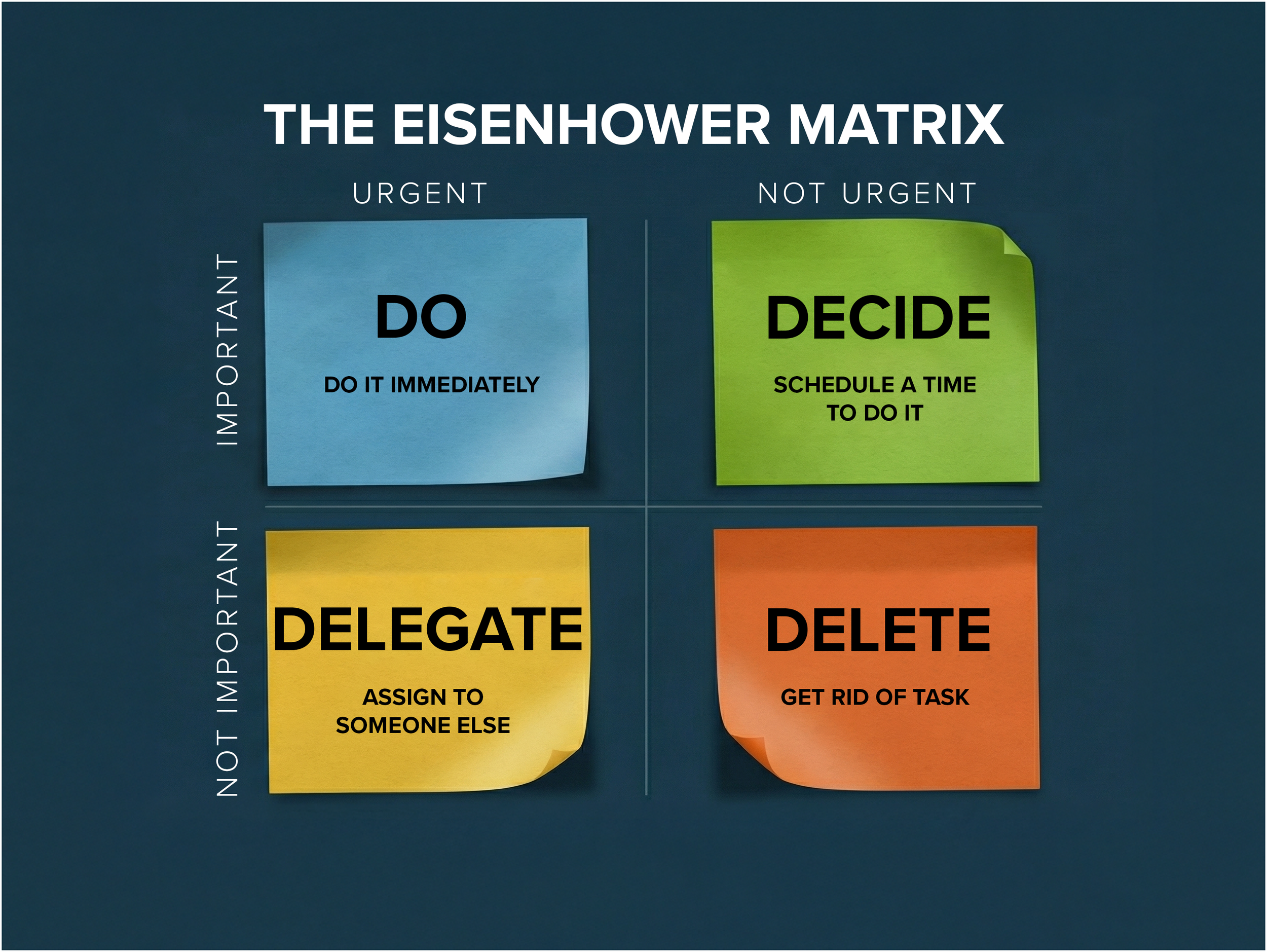
The Eisenhower Matrix
Urgent & Important: Do – action these things first
Important and Not Urgent: Decide – Schedule dedicated time to work on these with intention
Urgent & Not Important: Delegate – assign these actions to appropriate owners within your team, or minimize the time you spend on them
Not Urgent & Not Important: Delete – Get rid of these tasks by either delegating them or deleting the need for them
Inevitably there will be days where we find ourselves in fire-fighting mode. Yet as we become more skilled at teasing out the differences between urgent and important, our response to each fire will become more strategic, better informed, more impactful over time.
As I check off “Write Revelation #1” from my to-do list with satisfaction, I encourage you to join me in this renewed commitment to proactive excellence, ensuring our energy is spent where we can create the greatest strategic value in 2026.