
The real reason strategic plans die at implementation
4 of 26 Strategy Revelations for 2026
Somewhere in your organization right now, there is a strategic plan.
It has a cover page with your logo on it. Perhaps it was unveiled at a staff retreat or a board meeting with real energy and genuine excitement. A lot of time, energy, and thought went into creating it, printing it, and putting it in a binder. And then maybe it landed on a shelf?
And there is a non-zero chance it isn’t guiding anyone's decisions or behaviors.
This is not a cynical observation. It’s just what happens sometimes, when good intentions become overshadowed by the busy-ness of the day job. We all know that emails that don’t stop coming at you just because you have a newly declared set of priorities in hand.
There are plenty of explanations for why strategic plans fail at implementation: leadership misalignment, unclear priorities, insufficient resources, poor communication. These are all real factors. But after years of doing this work with organizations across government, tourism, education, nonprofit, and private sector, I have come to believe that the most common culprit is something simpler and more honest:
Unless your team’s behaviors changed on Tuesday morning, then Monday’s new strategic plan is just a fancy wish list.
A strategic plan is not a document; it’s a behavioral commitment. And most organizations move forward on Tuesday as though Monday never happened.
Here’s what I mean. Your plan might state a commitment to deepening community engagement and embedding diverse perspectives into decision-making processes. Beautiful! Aspirational! Genuinely measurable, if done right. But if you haven’t specified who will do what differently, by when, and what you will measure to know it happened, that aspiration is going to run head-first into the wall of existing to-do lists and familiar demands of organizational life.
We can look to neuroscience to better understand why that is such an obstacle. David Rock and Jeffrey Schwartz, in their foundational research on the neuroscience of organizational change, described the mechanism plainly: much of what people do at work is so habitual that the basal ganglia are running the show. The basal ganglia behave as the brain's autopilot, functionally executing habitual behavior efficiently, without the effort of deliberate decision-making or conscious thought. When we introduce a new strategic priority, it requires our prefrontal cortex to override that autopilot. That requires effort, it’s uncomfortable and unfamiliar, and it can get easily crowded out by the next urgent thing on the calendar. Without a concrete environmental cue to trigger the new behavior, the existing habit wins. Every time.
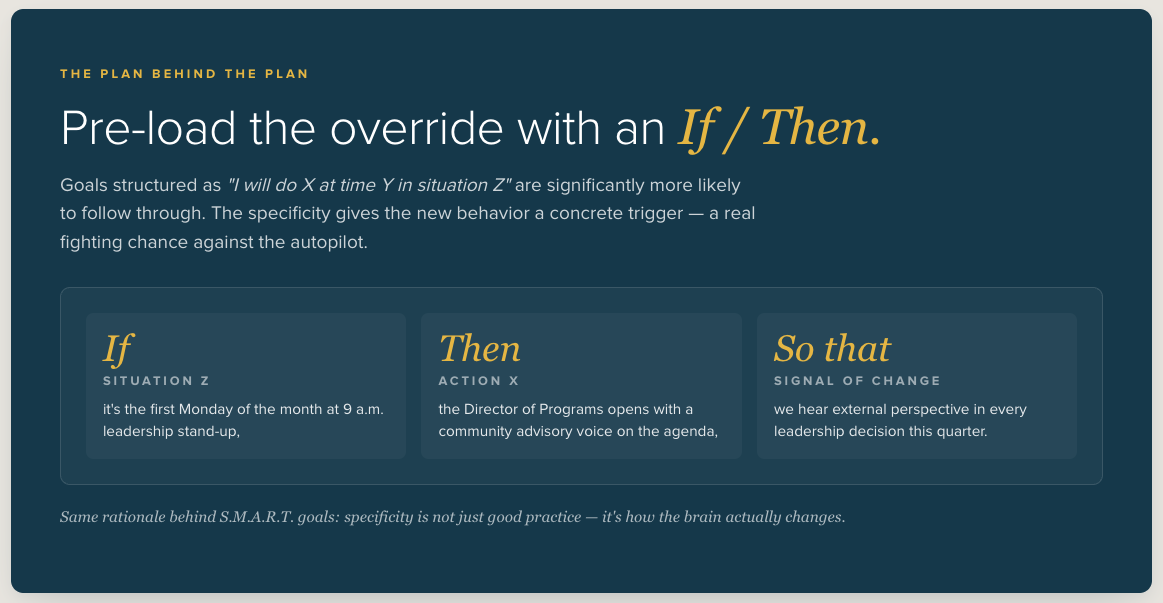
Peter M. Gollwitzer, "Implementation intentions: Strong effects of simple plans," American Psychologist 54(7), 493–503 (1999).
This is also why researcher Peter Gollwitzer's implementation intentions work at a neurological level. His decades of research show that people who structure goals as 'I will do X at time Y in situation Z' are significantly more likely to follow through than those who set goals without specifics. The if/then structure pre-loads the prefrontal cortex with a concrete trigger, giving the new behavior a real fighting chance against the autopilot. The specificity is not just good practice; it’s how the brain actually changes. This is the same rationale for S.M.A.R.T. (Specific, Measurable, Achievable, Relevant, Timebound) goals being a best practice for individual action and goal-setting.
At the organizational level, this plays out similarly. The leadership team spends two days at an offsite meeting building a plan that feels genuinely transformational. They leave aligned and energized. And then they return to a full calendar, an immovable budget, a set of performance metrics, and a team that were all built to support the previous strategy. Nothing in the operating environment has changed yet. The new strategic plan is now competing with the entire gravitational pull of how the organization functionally operated – yesterday.
'Culture eats strategy for breakfast' is one of the most quoted lines in organizational life (widely attributed to Peter Drucker, though the actual origin is murkier than the internet suggests. But I digress.). The point is clear, but let’s push it further. It is not just culture that eats strategy; it’s calendar. It’s budget allocation. It’s what gets measured in performance reviews and celebrated at all-staff meetings. If those things don’t change to reflect the new strategic priorities, the strategic plan was merely performative.
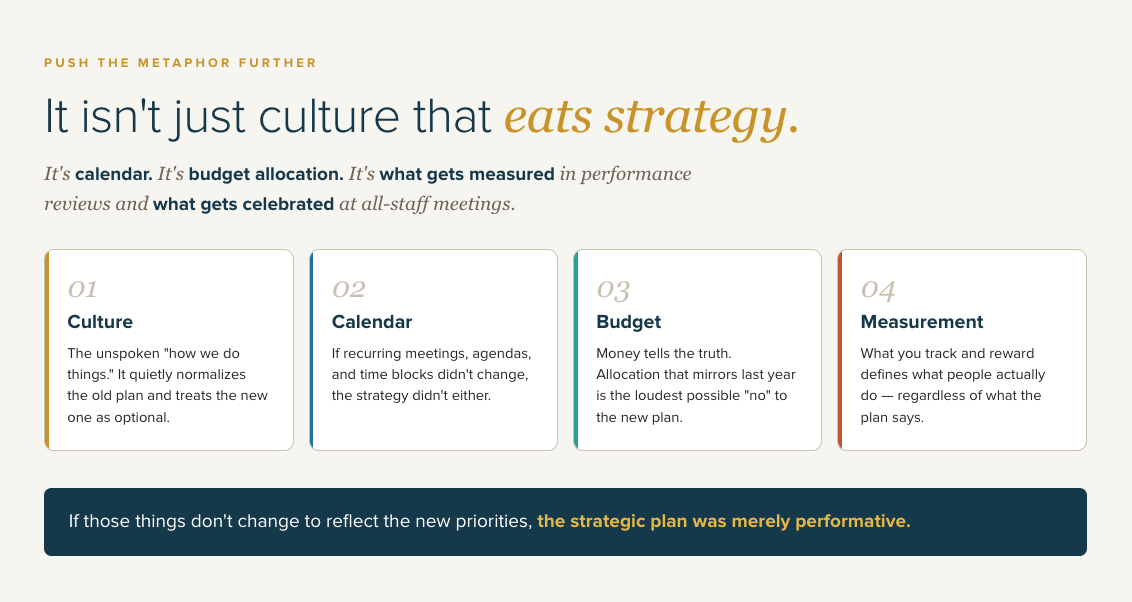
"Culture eats strategy for breakfast," widely attributed to Peter Drucker (origin contested).
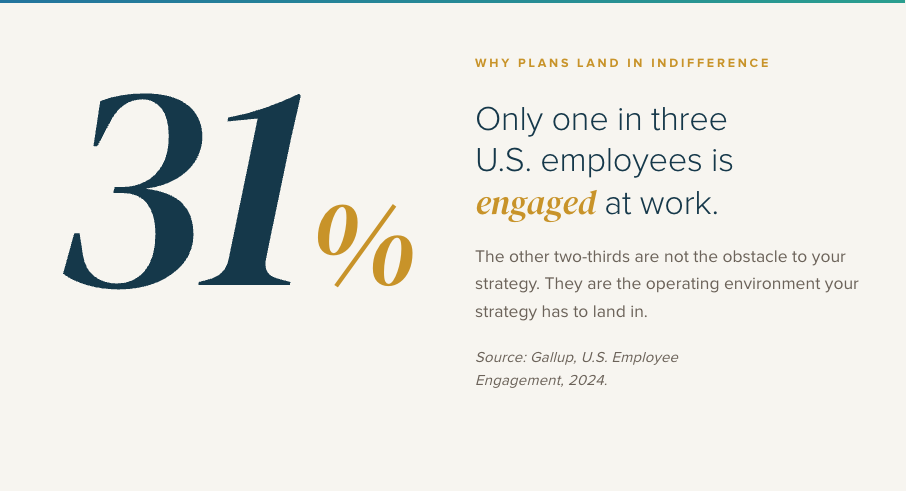
The problem is real: a 2024 Gallup study found that only 31% of U.S. employees are engaged at work. So that means that when your strategic plan arrives, roughly seven out of ten people in your organization are, at best, going through the motions. Your plan isn’t competing with a workforce primed for change. It’s competing against a very well-entrenched habitual default.
So what actually works?
Before you finalize your next strategic plan, perform what I call a behavioral audit. For every prioritized initiative, answer three questions:
What will someone – or multiple people – do differently because of this priority? Be specific. Not 'we will be more community-centered,' but 'the Director of Programs will include a community advisory voice in monthly leadership meetings starting in Q2.'
Who owns this behavioral commitment, and what will they need in order to make it stick? Ownership without resources or authority is theater (and we already covered the meeting-as-theater problem in Revelation #3).
How will you know when it’s happening? Name the specific indicator. Not the outcome metric, which will come later. What is the behavior that will tell you the change is actually occurring?
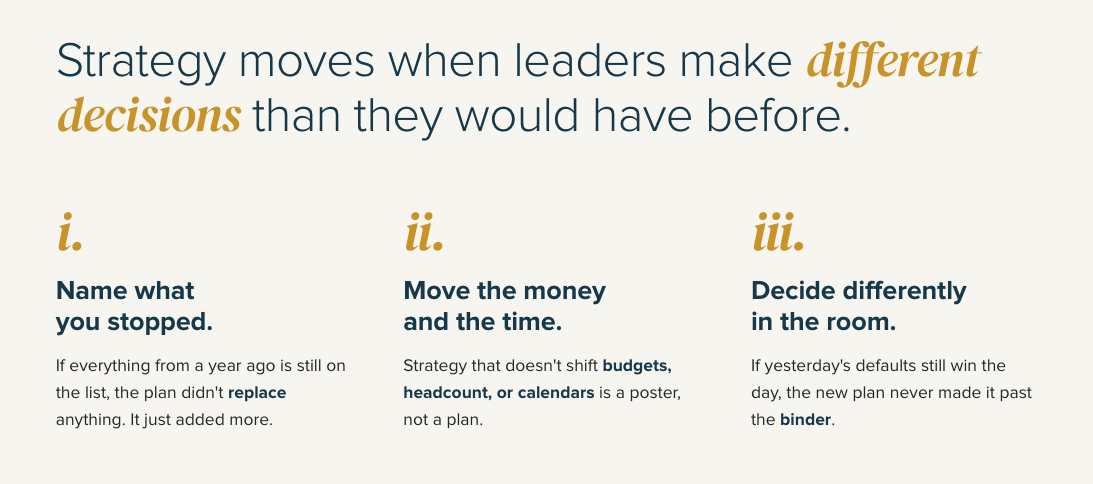
The plan isn’t finished until you can answer all three for every priority that matters. Everything else is still a draft.
Strategic planning done well is one of the most clarifying, energizing things a leadership team can do for the organization they lead. But the output of the planning process is not the document. It has to be the behavioral change the document is meant to produce. And changed behavior does not happen by accident. It happens because someone got specific about exactly how things would be different, and then built the accountability structures to hold that intention.
That is the plan behind the plan.
Most organizations never write it down. The ones that do are the ones you point to years later and say: they actually pulled it off.
Coraggio helps our clients move beyond strategic planning into successful change management for lasting behavioral change and organizational effectiveness. We’d love to help your organization succeed at implementing your goals.
SOURCES Peter Gollwitzer, 'Implementation intentions: Strong effects of simple plans,' American Psychologist, 54(7), 493-503 (1999)David Rock and Jeffrey Schwartz, 'The Neuroscience of Leadership,' Strategy+Business (2006)Gallup 2024 employee engagement data (31% engaged)Culture eats strategy for breakfast: widely attributed to Peter Drucker