
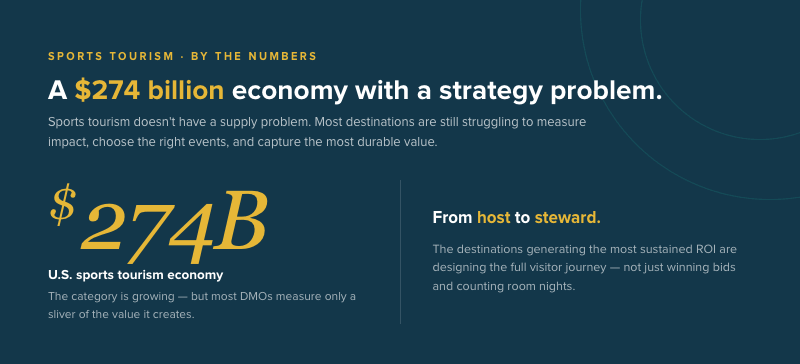
The $274 billion sports tourism economy doesn't have a supply problem. It has a strategy problem. Most destinations are still struggling to measure impact, determine what sporting events are right for their community, and leave the most durable value on the table.
I spent several days at the Sports ETA Symposium in Las Vegas, Nevada, listening to destination leaders work through a question that nobody quite said out loud: how does sports tourism fit into your organization’s and destination’s strategic goals?
After some reflection and insightful conversations with sports tourism leaders across the US, here are my five takeaways worth bringing back to your team.
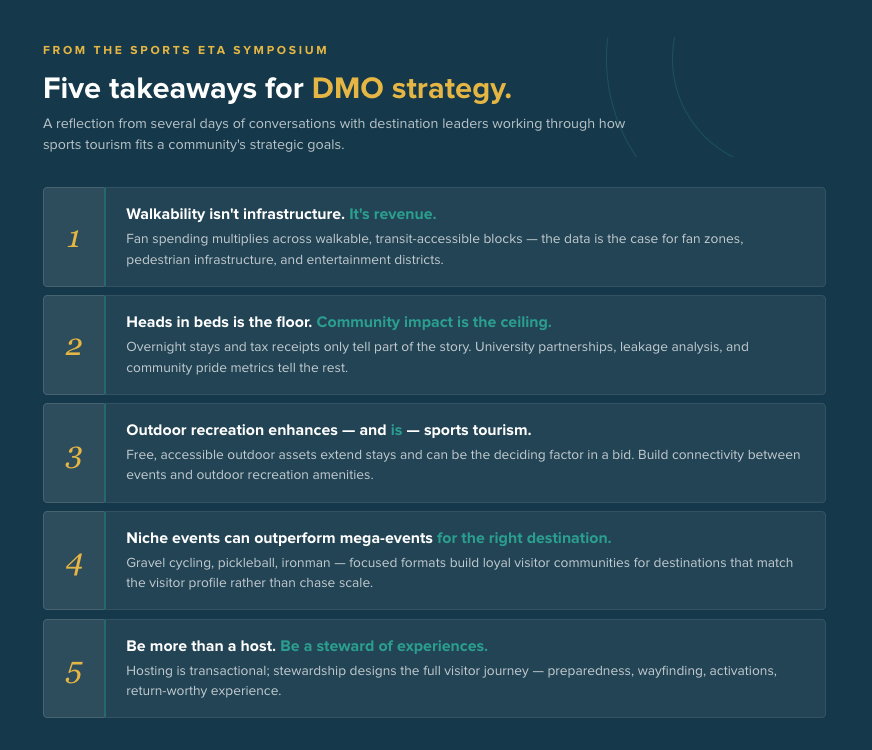
1. Walkability isn't infrastructure. It's revenue.
Zartico's session on the impact of mega-events mapped visitor spending in and around event centers, and the pattern is clear. When venues connect to walkable, transit-accessible neighborhoods, fan spending doesn't stay inside the arena. It multiplies across blocks. Nearby restaurants, retail, and entertainment districts all capture dollars that otherwise go unspent.
“So what?” for your organization: Your DMO can make a stronger economic case for fan zones, pedestrian infrastructure, and entertainment districts if you build the data infrastructure to back it up. That starts before the event by establishing spending baselines, setting up data-sharing agreements with nearby businesses, and identifying the tax revenue categories you plan to track. The destinations pulling this off are proactively designing a holistic measurements system in advance, so the demonstrated economic impact is undeniable.
2. Heads in beds is the floor. Community impact is the ceiling.
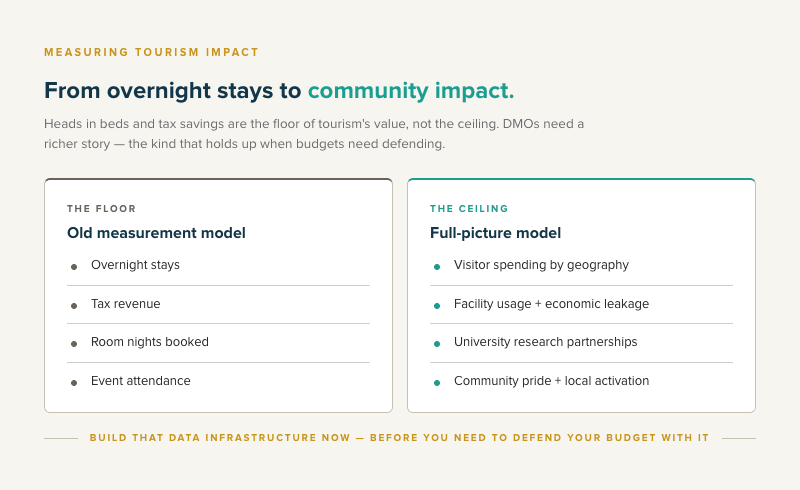
In the small and mid-sized DMO solutions roundtable, destination leaders from across the country acknowledged that citing overnight stays and tax savings as the primary success metrics is only telling part of the story. The alternatives they're using include university research partnerships, facility usage data, leakage and opportunity cost analysis, and local activation metrics that capture community pride. The key to championing the impact of tourism is using these metrics for community impact routinely, systematically, and proactively.
“So what?” for your organization: Your stakeholders need a richer story that is more meaningful to their own experience and perspective. DMOs need to be more creative and compelling in telling the story of tourism. Overnight stays and tax savings only tell an impersonal part of story, and it’s crucial to think about the local experience and quality of life components that can be measured to show local and specific community benefit. Build that data infrastructure now, before you need to defend your budget with it.
Source: Sports ETA Small & Mid-Sized DMO Solutions Roundtable, 20263. Outdoor recreation enhances – and is – sports tourism.
The Southern Nevada IMBA chapter framed this clearly: outdoor recreation is a lever to help extend the stays of sports tourists. Free, accessible outdoor activities can lengthen visitor stays and make a sporting event more attractive to out-of-town attendees who are deciding between comparable destinations. In the DMO solutions roundtable, Ocean City, MD described how they position their beach access as an explicit selling point for youth tournament recruitment.
“So what?” for your organization: Take inventory of what outdoor assets could be a selling point for your sports tourism visitors. A great bike path, river access, or trail system might be the deciding factor in a bid you're currently losing on price. Also consider how to improve the connectivity or wayfinding between your events and your outdoor recreation amenities.
4. Niche events can outperform mega-events for the right destination.
From gravel bike races to pickleball tournaments, these formats are building loyal visitor communities in smaller destinations that chose to specialize rather than compete for larger events their destinations do not have capacity to host. The ROI math on a well-run niche event, in a destination that genuinely fits the visitor profile, is frequently stronger than a larger event that may strain community infrastructure.
“So what?” for your organization: Bigger isn’t always better, or even possible! Sometimes targeted and niche events that fit your destination capacity can have a huge ROI. Many smaller destinations have found success leaning into smaller, niche events and creating a unique culture and draw to the destination. Events like gravel cycling, ironman races, or pickleball tournaments can create strong followings and visitor loyalty if they have a positive experience in your community.
5. The shift from host to steward is where the real ROI lives.
Hosting is transactional: win the bid, fill the rooms, and count the dollars. Stewardship is the design of the full visitor journey and community experience: business preparedness, stakeholder engagement, wayfinding, connectivity between events, activations that fill the gaps. The destinations generating the most sustained impact are building experiences that visitors choose to return to.
“So what?” for your organization: Ask whether your destination is ready to manage the impact, distribute the benefit, and protect the resources involved. This applies equally to a mega-event in a metro core and a trail system in a rural county. Stewardship is the strategic frame that makes both scalable.
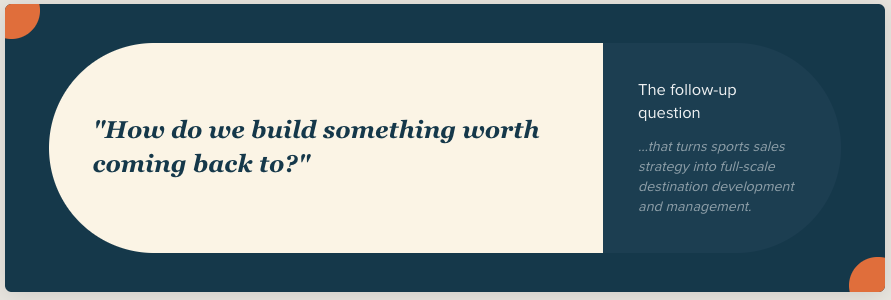
Sports tourism is rewarding the destinations that ask a follow up question after, "how do we win more bids?" And that question is, "how do we build something worth coming back to?" This extra question will help transform your sports sales strategy into full-scale destination development and management. And we’re here to help you with that transition.

Aviva North is an Associate Principal at Coraggio Group, where she contributes to destination stewardship and outdoor recreation strategy. She advises DMOs and destination organizations on sustainable planning, community-centered tourism development, and the organizational infrastructure needed to make strategy stick.
SOURCES Sports ETA Symposium, 2026 — Session notes and roundtable summaries Zartico, Visitor Spending Proximity Analysis (cited in Sports ETA presentation)