
The meeting that should have been a decision
3 of 26 Strategy Revelations for 2026
You know the meeting I'm talking about.
Everyone in the room already knows the answer. The analysis is done. The options have been presented three times, in three formats, to three overlapping subcommittees. And yet here you are, staring at a calendar invite for a follow-up meeting to discuss the outcomes of the meeting about the meeting.
At this point, the meeting has had more sequels than Fast and Furious.
This is not a process problem. It is a decision avoidance problem.
In government and nonprofit organizations especially, I see this pattern with painful regularity. The culture of consensus (which is genuinely valuable when it comes to community representation, stakeholder buy-in, and equitable governance) can quietly metastasize into something else entirely: a system in which no one person is ever clearly accountable for a decision, and meetings become the organizational equivalent of kicking the can down the road.
Here is the thing nobody says out loud in that conference room: we already know what the right call is. They just do not want to be the one to make it, lest they become the de facto owner of its implementation. Which, if we are being honest, is a very human and completely relatable instinct. It is also a very expensive one.
Neuroscientist David Rock's SCARF model explains the mechanism. Rock's research at the NeuroLeadership Institute maps five domains the brain monitors as survival signals: Status, Certainty, Autonomy, Relatedness, and Fairness.
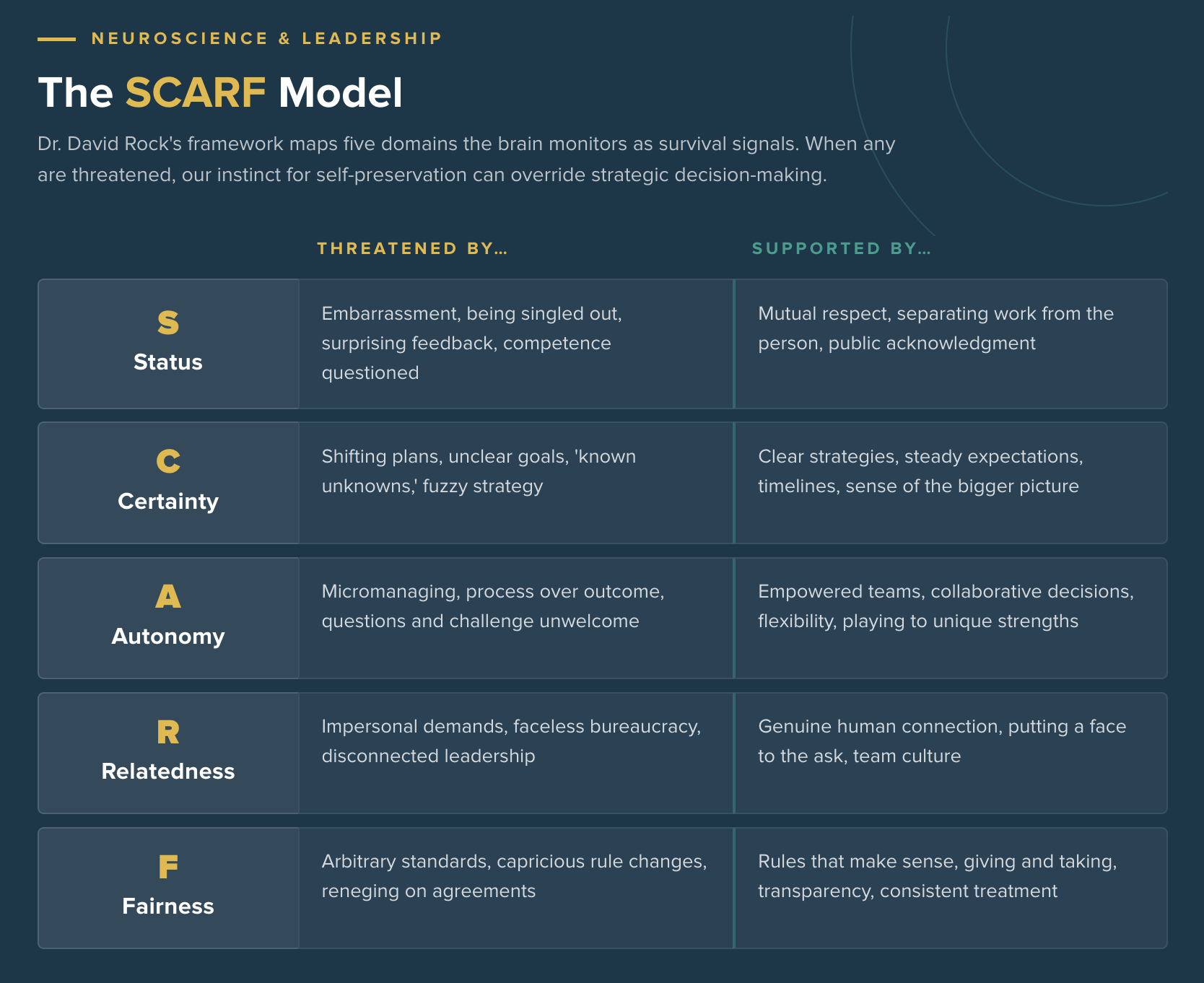
When any one of these feels threatened, the amygdala (the brain’s emotional processing center) fires up and the prefrontal cortex (the brain’s executive decision-making center) gets partially derailed. The person who makes a consequential choice – in front of a room full of colleagues – may experience a direct hit to their sense of status and certainty. The brain doesn’t register this as a management situation; it registers it as a personal risk and it attempts to steer reliably toward the safest available option. In some organizations, that may result in scheduling another meeting, seeking clearer consensus, or even choosing a less strategic but less risky outcome for the individual. While this cycle is a sign that the brain is doing its job of self-preservation, we must find ways to overcome our fight-or-flight instincts to be the most effective leaders we can be.
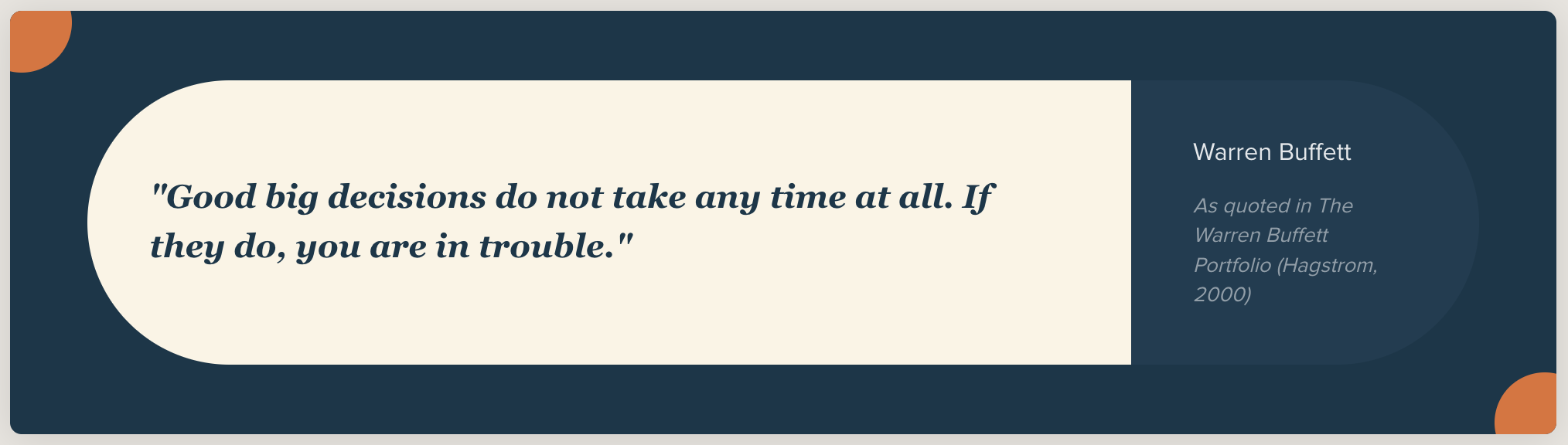
In his 2024 Berkshire Hathaway shareholder letter, Warren Buffett credited his longtime business partner and late Vice Chairman Charlie Munger with warning against a “thumb-sucking” approach to making decisions. Delaying or wishing away the need to make a decision, no matter how uncomfortable it may feel at the time, only compounds the problem in the long run. Decisiveness serves to reduce further harm and speeds up necessary change to achieve intended outcomes. But decisiveness cannot succeed unless it is embraced and understood across organizational management at all levels. Buffett’s leadership philosophy is rooted in the empowerment of smart, talented teams to enable well-informed decisions – and the belief that learning from mistakes results in the ability to make better decisions in the future. When paired with a culture of mistakes-as-learning, decisiveness becomes a competitive advantage.
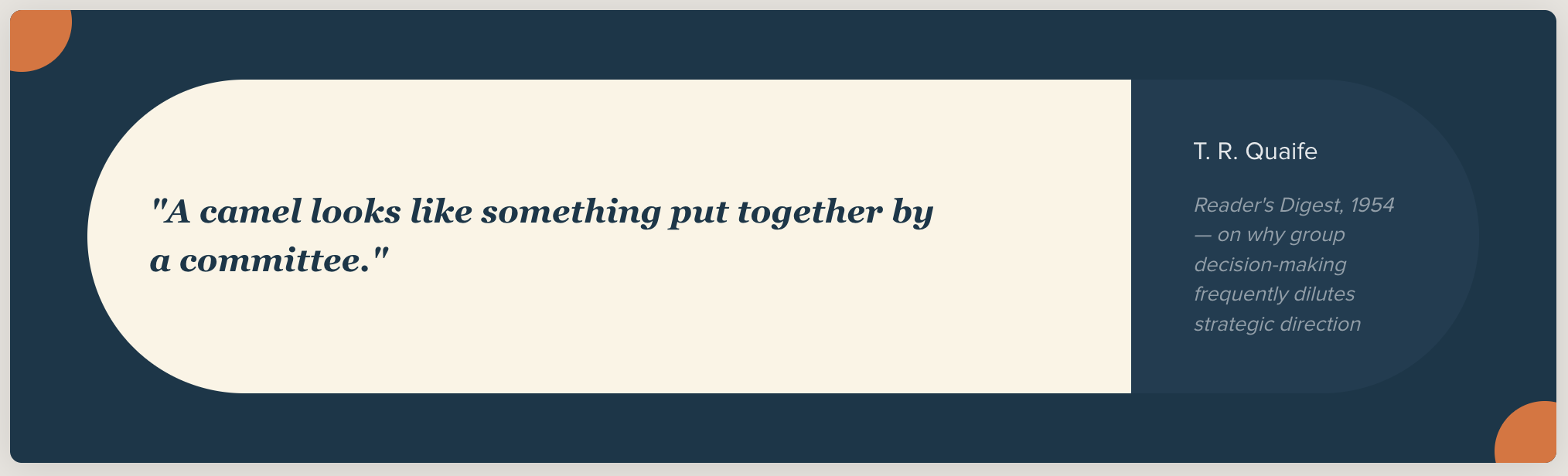
While individual decisiveness is important for effective leadership, there is another decision-making wrinkle worth naming. Group decision-making, despite its democratic appeal, is frequently less effective than individual decision-making. When the tendency of a group is to equitably incorporate all input, we inadvertently compromise the power of a singular, strategic direction toward an agreed goal. Alternatively, the most senior person's preference poses the risk of quietly dominating the room, especially if that leader is predisposed to a micro managerial or autocratic style (and no one wants to be that guy, right?). In his 2007 book Web Analytics: An Hour A Day, Avinash Kaushik coined this “the HiPPO effect”: the Highest Paid Person's Opinion. When everyone defers to the most senior voice in the end anyway, the committee deliberation was nothing but theater. Expensive, time-consuming theater, with a catered lunch if you’re lucky.
So how can you avoid these pitfalls?
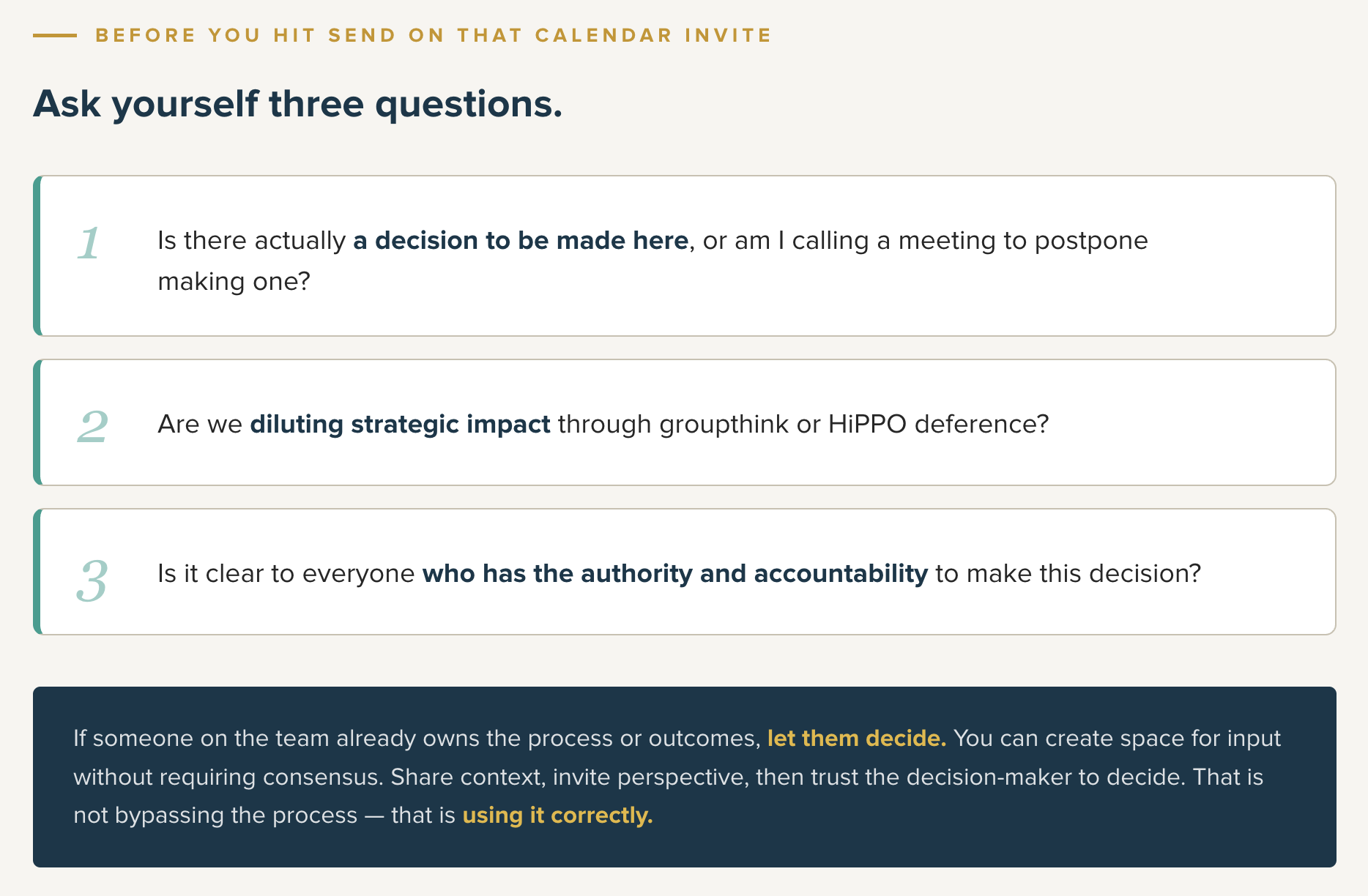
If it is unclear who has the authority to make the decision, then you have more work to do on your empowerment and delegation as a leader.
Meetings are genuinely vital to organizational life. They build alignment, surface dissent, and create shared ownership of outcomes. But when a meeting is simply a venue for deferring accountability, it’s not serving anyone. Instead, it’s imploding everyone's calendar while the work waits and the decision-maker hides behind an agenda.
The next time you are about to schedule another round of deliberation on something that has been in deliberation for weeks, pause long enough to ask: is this really a meeting? Or is this a decision that is avoiding the light of day?
Coraggio works with leaders and their teams to advance healthy organizational culture that supports strategic decision making and accountability to drive meaningful, measurable outcomes.
SOURCES Warren Buffett, 2024 Annual Letter to Berkshire Hathaway Shareholders — Berkshire Hathaway (February 2025). Available at: https://www.berkshirehaway.com/letters/2024ltr.pdfHiPPO Effect: widely referenced in behavioral economics and product management; popularized by Avinash Kaushik, Web Analytics: An Hour a Day (2007)David Rock, SCARF Model, NeuroLeadership InstituteHBR / NeuroLeadership Institute: '3 Ways Our Brains Undermine Our Ability to Be a Good Leader' (2023)HBR / NeuroLeadership Institute: '3 Ways to Compassionately Hold Your Team Accountable' (2024)