
From Fiji to Phuket: What Eight Months Reveals About the State of Sustainable Tourism
The question I keep coming back to, walking into Phuket this week, is one the industry hasn't been willing to answer out loud: are we actually changing, or have we just gotten very good at talking about change?
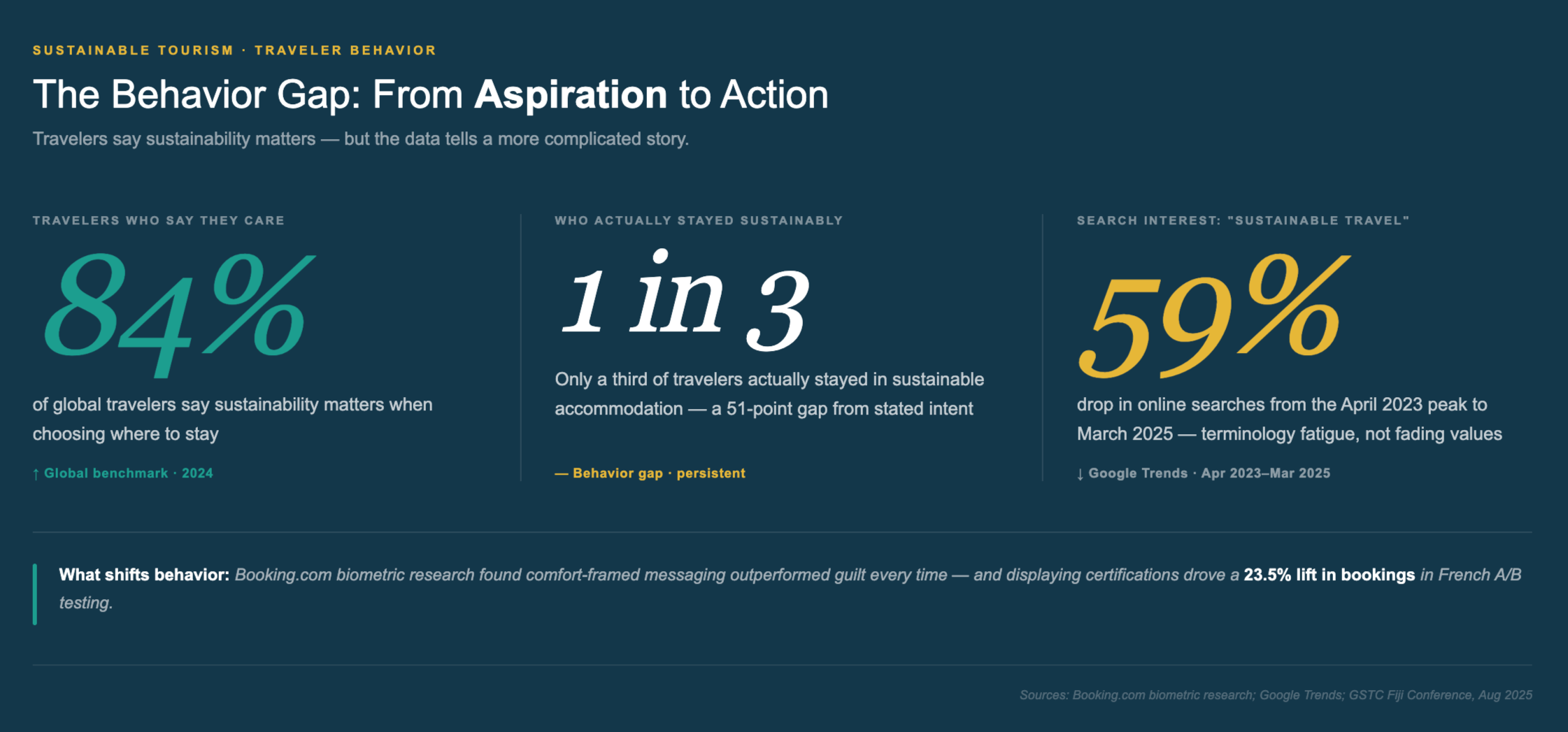
Eight months ago, I left the GSTC Global Conference in Fiji with a notebook full of frameworks and a genuine sense of forward motion. The Cook Islands presented a beautifully grounded indigenous stewardship philosophy – mana tiaki – as the foundation for destination planning. Park City showed how a GSTC assessment becomes a real baseline for certification. Booking.com brought biometric research proving that how we talk about sustainability to travelers matters as much as whether we practice it. Comfort-framed messaging outperformed guilt every time, and displaying certifications drove a 23.5% lift in bookings of sustainable properties in French A/B testing.
That research landed because it named something the industry had been circling around for years. Travelers say they care. But the behavior gap is stubborn. Sustainability still matters to 84% of global travelers, yet only a third report staying in sustainable accommodation in the past year. Online searches for "sustainable travel" peaked in April 2023 and dropped 59% by March 2025. That's either a sign of fatigue with the terminology, or the optimist's read: behavior that's been so normalized it no longer needs to be Googled. I lean toward fatigue.
What's different at Phuket is the conference's willingness to stop accepting intent as a metric. The agenda is built around accountability: data-driven measurement for DMCs, quantifying social and environmental impact, and the explicit argument that sustainability is profitable. The question being posed this week isn't whether to commit. It's how to measure, verify, and embed that commitment into financial decision-making.
The US context is where this gets harder to ignore.
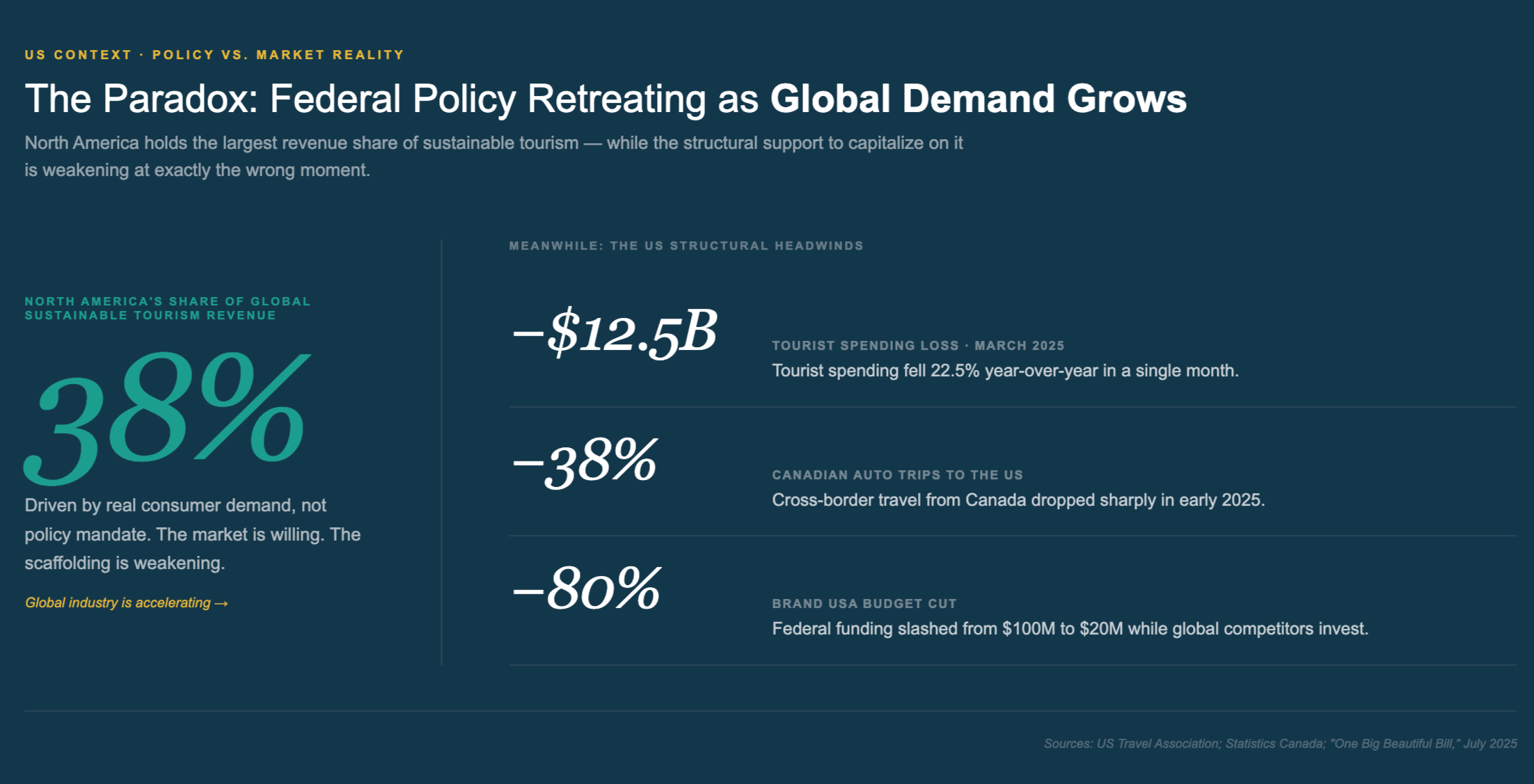
The backdrop for American practitioners right now is genuinely turbulent. The "One Big Beautiful Bill" passed in July 2025 rescinds unused federal sustainable aviation fuel infrastructure funds, eliminates fuel economy penalties for automakers, and cuts Brand USA's budget from $100 million to $20 million. International arrivals dropped sharply in early 2025. Tourist spending fell 22.5% year-on-year in March, a loss of $12.5 billion. Canadian auto trips to the US dropped 38%.
The paradox is hard to sit with. Federal policy is retreating from sustainability infrastructure at the exact moment the global industry is accelerating toward it. North America still holds the largest revenue share of sustainable tourism at 38%, driven by real consumer demand. But the structural scaffolding that would help US operators capitalize on that demand is weakening precisely when it should be strengthening.
The argument I've been making to clients for the past year hasn't changed: don't wait for federal will. The most durable sustainability strategies right now are being built at the sub-national level, through state and city DMOs, private sector coalitions, and international frameworks like GSTC that don't depend on political winds in Washington. That independence isn't a workaround. It's increasingly the strategy itself.
What eight months actually changed
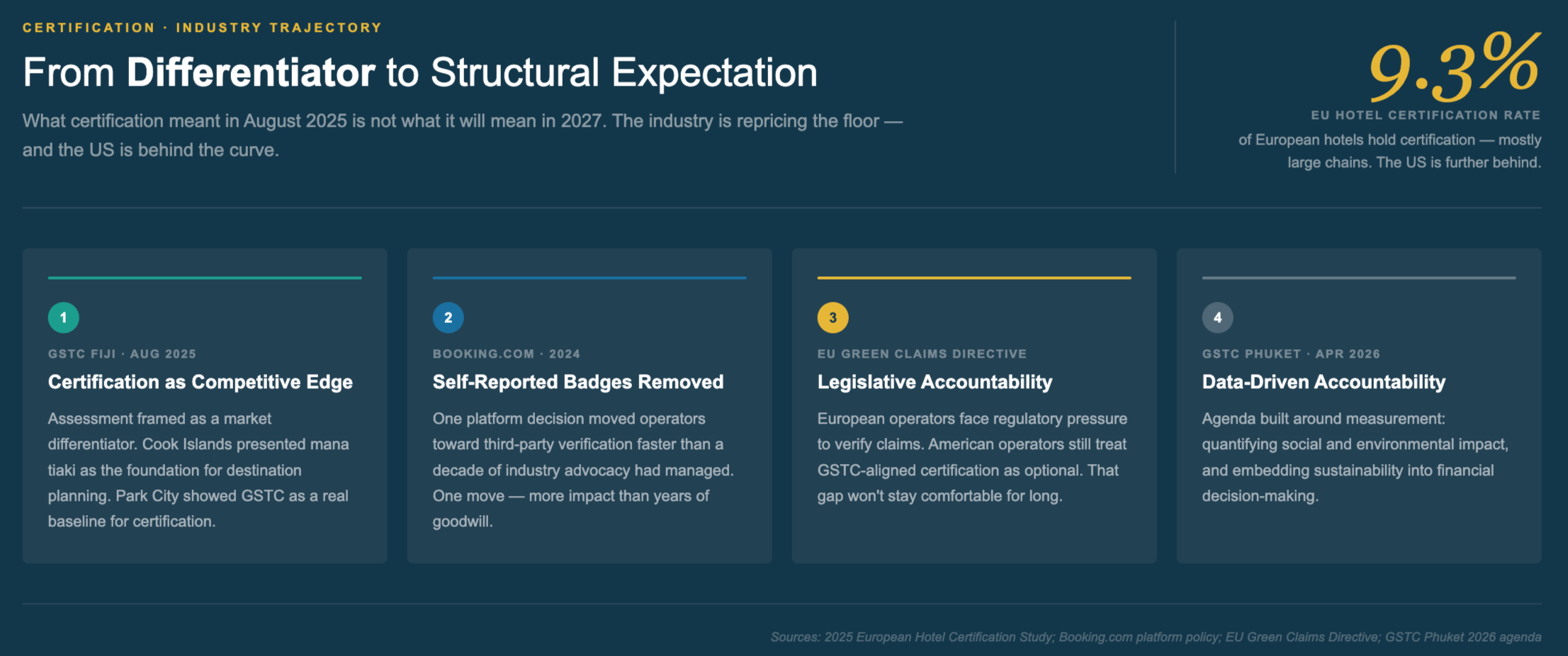
In Fiji, certification was framed as a competitive differentiator, something that set you apart in a crowded market. Since then, the framing has shifted structurally. A 2025 study found that only 9.3% of European hotels hold certification, concentrated largely among large chains. Booking.com's 2024 removal of self-reported sustainability badges pushed operators toward third-party verification faster than years of industry advocacy had. One platform decision moved the needle more than a decade of goodwill.
The US market hasn't absorbed that lesson yet. European operators are already contending with legislative pressure from the EU's Green Claims Directive. American operators still largely treat GSTC-aligned certification as optional differentiation. That gap won't stay comfortable for long.
On the operational side, something meaningful has shifted in how regenerative tourism is being treated. In Fiji, restoration and transformation were still somewhat aspirational, language that felt right but hadn't fully landed in operations. The Phuket agenda is different: circular waste systems, AI-powered food waste tracking, natural area visitor management, and a newly developed GSTC Standard for Food and Beverage, the sixth in the standards family.
That breadth reflects what I'm seeing with clients. The sustainability function is no longer a standalone department with its own budget and reporting line. It's being embedded into operations, procurement, finance, and HR simultaneously. One session on the Phuket agenda addresses something I'd call the real frontier right now: why well-designed sustainability programs consistently fail to translate into day-to-day performance. That's not a standards problem. That's an organizational change management problem. It's the least glamorous part of this work, and it's the most consequential.
The signal in the granularity
Looking across both agendas, the most telling shift isn't any single issue. It's who is now being asked to act. In Fiji, the conversation was largely sector-level: destinations, certifiers, NGOs, major hotel groups. Phuket is pointing to far more specific actors. Tour operators managing supply chains. Micro-enterprises navigating capital access. Kitchen managers reducing food waste. Digital platforms embedding verified sustainability data at the point of sale.
That granularity is the signal. Sustainable tourism has moved out of the conference room and into the operational detail of the industry. The frameworks exist. The standards are being revised on the basis of real-world feedback. The profitability case is being built with data, not just conviction.
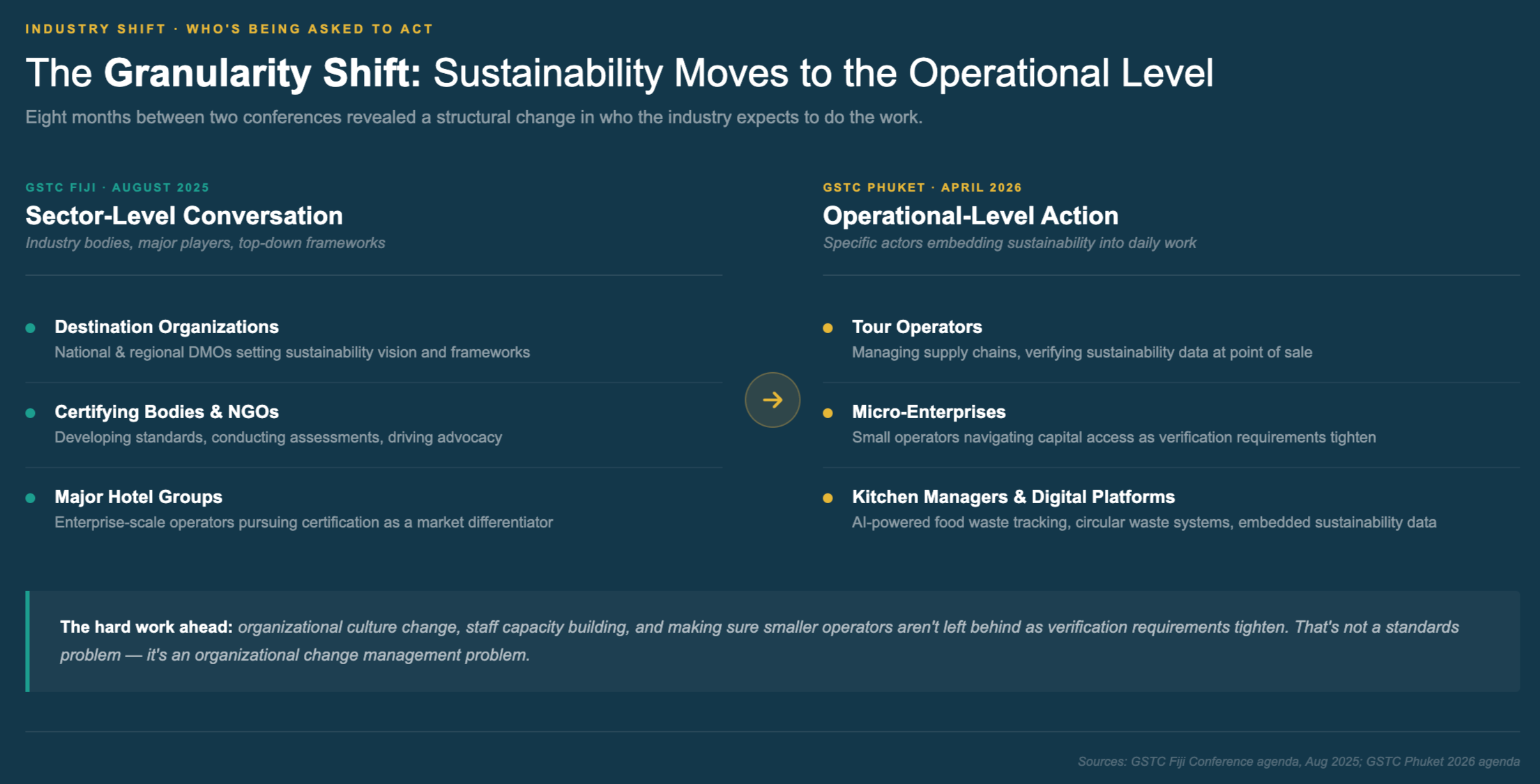
The hard work ahead is the kind that doesn't make for good keynotes: organizational culture change, staff capacity building, and making sure that smaller operators aren't left behind as verification requirements tighten. That's the work my practice focuses on, helping destinations and organizations build the internal infrastructure to actually execute on the commitments they've made.
Eight months between conferences is a short window. But in the context of what Fiji described — climate risk, overtourism, biodiversity loss, economic leakage — it's long enough to see whether an industry is accelerating or stalling.
My read going into Phuket: accelerating. And the organizations paying closest attention to how are the ones that won't be scrambling to catch up five years from now.

Andrew Leary is a Principal at Coraggio Group, where he leads the firm's Travel and Tourism practice. He advises destinations, DMOs, and tourism-adjacent organizations on strategic planning, organizational readiness, and the operational infrastructure required to make strategy stick. He is presenting twice at GSTC Phuket 2026, April 22 through 25.
Data cited is sourced from publicly available research. This post reflects Andrew's observations from GSTC Fiji (August 2025) and a preview of the GSTC Phuket 2026 agenda.