
AI is already in your organization. The question is who and what's driving it.
Does it matter whether AI adoption happens top-down or bottom-up?
A few weeks ago I was in a conversation with a client — a destination management organization, mid-sized, well-run, thoughtful leadership — and someone mentioned almost in passing that two of their team members had been using ChatGPT to draft social captions for months. No policy. No shared prompt library. No one leading it. Just two people who figured it out on their own and kept quiet about it because they weren't sure if it was allowed.
That story is not unusual. I've heard versions of it in nearly every sector we work in: government agencies where frontline staff are using AI to summarize meeting notes while leadership is still debating whether to form a task force to begin framing AI policy. Nonprofits where the development director has quietly built a grant-writing workflow in AI tools while the executive director assumes the team is still writing everything from scratch. Schools where teachers are using AI to differentiate lesson plans while the district is still writing its acceptable use policy.
The point is: AI is already in your organization. The question is not whether your team is using it. The question is whether anyone is leading it.
Revelation 5 of 26
The risk of unled AI adoption is not primarily a technology risk. It's a strategy risk.
When AI usage in an organization is fragmented and invisible, a few predictable problems emerge. First, outcomes become inconsistent. One team member's AI-assisted work reflects their individual prompting habits, their comfort level with the tool, and their own judgment about what's accurate and appropriate. Another team member's does not. The organization loses coherence across its outputs without ever knowing why.
Second, organizational learning stalls. When individuals adopt AI in isolation, the insights stay siloed. The person who found an excellent prompting approach for grant writing never tells the colleague who's struggling with the same task. The team that figured out how to use AI for data analysis never shares the workflow with a department that could benefit. The organization as a whole learns nothing, because there's no shared system for capturing what works.
Third, and most consequentially, risk management becomes impossible. AI tools can hallucinate, reflect bias, generate outputs that are factually wrong, or produce content that is legally or ethically problematic for specific sectors. A government agency that has never discussed how staff should verify AI-generated information is one accidental citation away from a credibility problem. A nonprofit that has never thought about AI and donor data privacy is one data policy audit away from a compliance issue.
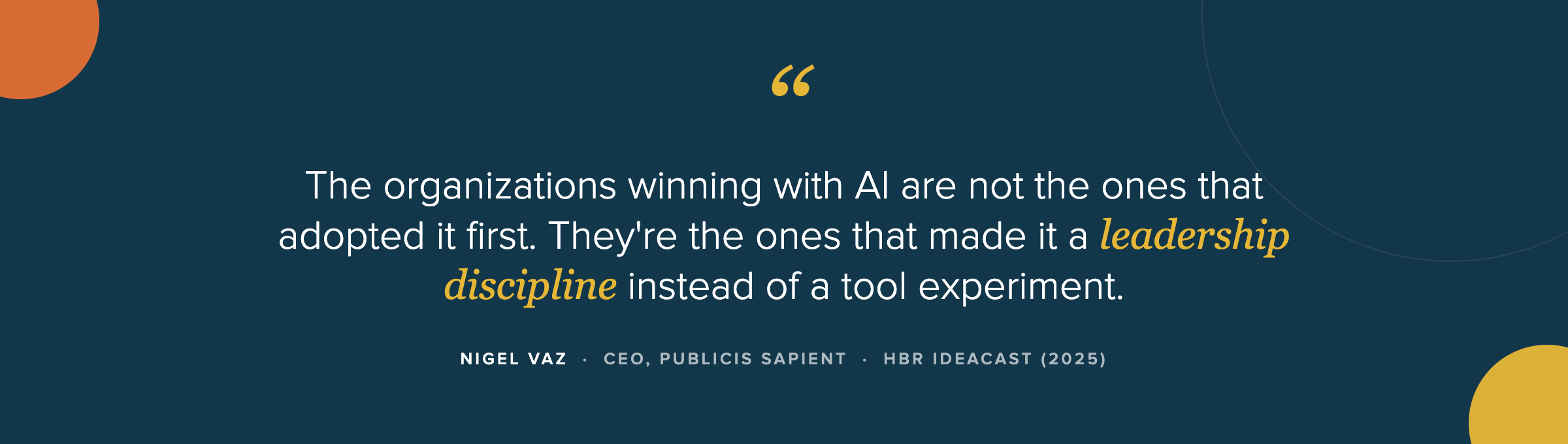
The research from Harvard Business School's AI Strategies for Business coursework is clear on this: the organizations that get the most durable value from AI adoption are those where leadership actively shapes how AI is used, not those where AI spreads by individual initiative alone. The distinction matters because AI, when thoughtfully directed, can raise the floor for an entire organization: the HBS-cited research on Boston Consulting Group consultants found that AI assistance improved productivity for lower performers by over 40%, narrowing the gap between the team's top contributors and everyone else. But that outcome only materializes when adoption is structured and shared, not hidden and piecemeal.
There's a parallel from organizational psychology worth naming here. In 1969, organizational theorist Victor Vroom published his expectancy theory of motivation, arguing that people's behavior at work is shaped by three factors: the belief that their effort will lead to a result, the belief that the result will lead to a reward, and the value they place on that reward. When AI is adopted informally and without organizational endorsement, that first condition collapses. Team members who are trying to do the right thing don't know whether their AI use is valued, tolerated, or covertly discouraged. In that uncertainty, some will use it anyway. Others will stop. Neither group is making a fully informed choice, because no one has given them a framework to make one.
That is a leadership failure, not a technology failure.
Three things worth doing now
If you're leading an organization of any size, here is where I'd start:
Name AI governance as a leadership function. Not a technology function. Not an IT ticket. Someone at the leadership level needs to own how the organization is approaching AI, what it's being used for, what the guardrails are, and how learning gets shared.
Audit before you strategize. Before you build a policy, find out what's actually happening. Ask directly. You may be surprised — and that surprise is useful data. Understanding the informal AI reality in your organization is the first step to shaping the formal one.
Create shared infrastructure for what you learn. A shared prompt library, a simple internal guide on what AI is and isn't appropriate for, a monthly 15-minute team conversation about what's working: these are lightweight, high-return investments that turn individual trial-and-error into organizational knowledge.
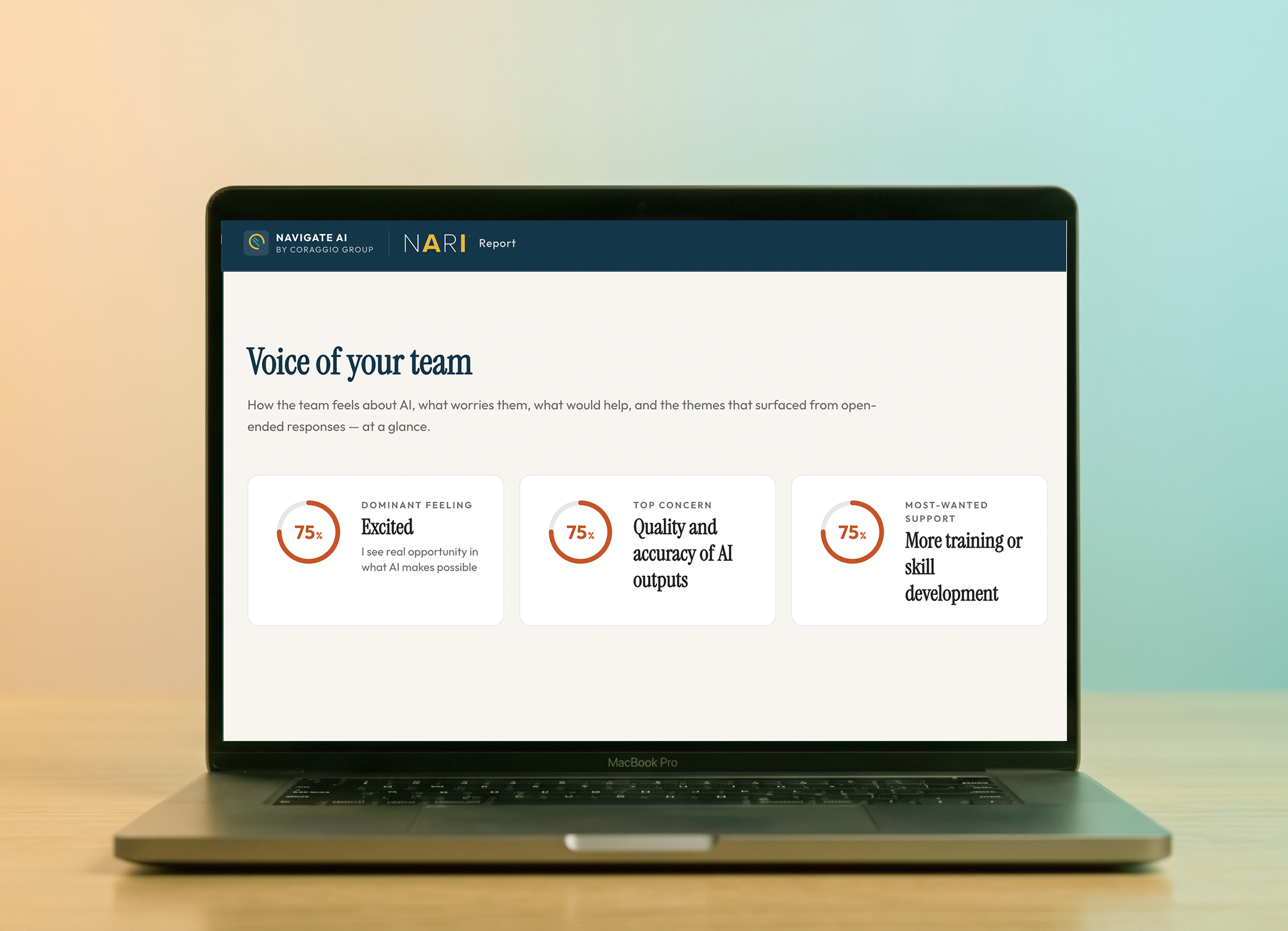
AI literacy in an organization is like any other kind of literacy. Left to chance, it produces a wide and inequitable spread of capability. Led intentionally, it becomes a competitive advantage. The choice about which outcome you get is a leadership choice, and it belongs on your strategic agenda.
Coraggio's Navigate AI practice helps organizations move from informal, fragmented AI use to a structured organizational approach, including our NARI readiness assessment. If you're not sure where your organization stands, that's exactly the right place to start.
SOURCES FOR REVIEW
HBS Online, "AI Strategies for Business" (2025). Harvard Business School Online coursework on organizational AI adoption.Ethan Mollick and others, BCG study on AI-assisted consultant performance (cited in HBS AI coursework, 2024–25). Found 40%+ productivity improvement for lower-performing consultants.Victor Vroom, Work and Motivation (1964). Expectancy theory of organizational behavior.Nigel Vaz, HBR IdeaCast, "A New Era of AI-Driven Business Strategy" (2025). On AI as organizational discipline vs. tool experiment.Coraggio Group, Navigate AI / NARI (2026). Organizational AI readiness assessment instrument.