
Beyond Seat-Warmers
Six Principles for Boards That Advance the Mission
Every nonprofit and destination marketing organization has a board. Not every organization has a board that helps it move. The difference is rarely about the caliber of individuals around the table. It is almost always about how those individuals were recruited, oriented, equipped, and asked to contribute. A board is a tool. It has utility. When that utility is clear and consistently exercised, the organization accelerates. When it is not, the board becomes ballast at best and an active drag at worst.
This post distills six principles drawn from Coraggio Group's work with numerous destination marketing organizations, public-sector agencies, and nonprofit boards. Each principle has been tested in the field, and each addresses a pattern we see repeatedly. None of them are about meeting mechanics or bylaw language. They are about the relationship between governance and mission, and the disciplined choices a CEO and a board chair have to make together to keep that relationship productive.
Principle 1: Recruit for Mission Utility, Not Resume
Most board recruitment starts with the wrong question. The default question is, who is impressive and available? The right question is, if our organization had a voice, what would it ask of a board over the next three years? Strategic direction, anticipated challenges, and the specific contours of the work ahead should drive the recruitment slate. Subject matter expertise still matters. It matters enormously. But expertise has to be a match for what the mission needs next, not a credential collected for its own sake.
When boards are built around prestige rather than purpose, members arrive with no clear sense of why they are there. Some default to performing their expertise. Some default to warming the seat. Very few of them connect their presence to a specific mission outcome, because no one ever asked them to. The fix is unglamorous yet effective. Before any name goes on a candidate list, the nominations committee and CEO should write a one-page statement of what the board needs to be able to do for the organization in the coming term. Recruitment then becomes a casting exercise against that statement.
Principle 2: The CEO and Board Chair Must Work in Lockstep
A strong board chair is one of the most valuable assets a CEO can have. A weak board chair is one of the most expensive liabilities. The chair sets the tone, runs the meeting, and signals to the rest of the board what good engagement looks like. When the chair is passive, the board drifts. When the chair is misaligned with the CEO, the board fractures.
The chair-CEO partnership is built between meetings, in working sessions where the two of them set the syllabus for the year. What are the three or four topics that warrant deep board attention this quarter? Where do we need the board's influence and credibility? Which decisions are ours to make, and which ones genuinely require board input? When that pre-work is done well, board meetings become substantive. When it is skipped, meetings devolve into reporting out and reacting.
The CEO has a related job, which is to enter every board conversation as an equal. Boards left to their own devices often drift into a posture of questioning every decision. CEOs who simply answer those questions without offering a counter-frame reinforce the dynamic. The healthier move is to acknowledge the questions, share what the CEO needs from the board in return, and be willing to disagree out loud, with respect and without flinching.
Principle 3: Nose In, Hands Off
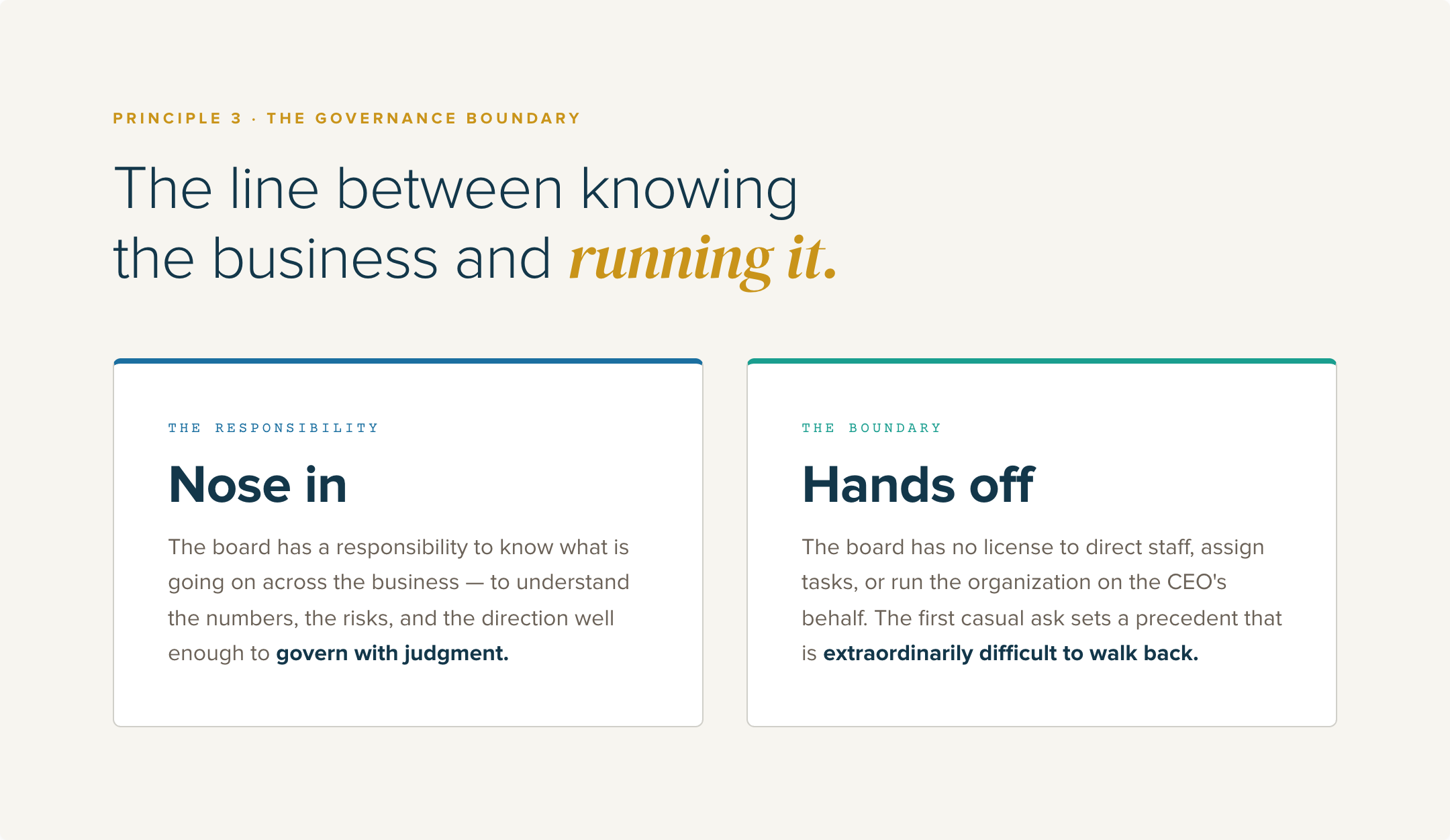
This is the single most useful governance principle we teach. The board has a responsibility to know what is going on across the business. Nose in. The board does not have a license to direct staff, assign tasks, or run the organization on the CEO's behalf. Hands off.
The principle sounds simple but is fundamental. The first time a board member calls a staff member directly to request a piece of work, a precedent is set that is extraordinarily difficult to walk back. We have watched organizations spend years trying to recover the boundary that one casual ask erased. The CEO has a responsibility to protect the boundary, and the board chair has a responsibility to reinforce it. New board members should hear the principle on day one, and they should hear it again every year. It is not a rule about whose feelings get hurt. It is a rule about what makes the organization function.
Principle 4: Equip the Board, Every Meeting and Every Year
Onboarding can’t just be handing a new board member a binder. A new board member who receives a packet of bylaws, financials, and a strategic plan has been informed. They have not been equipped. Equipping a board is a continuous investment, and the return on that investment is measured in the quality of the questions board members ask, the depth of the conversations they have, and the speed with which they get to good decisions.
The practical commitments look like this. Every meeting agenda should include at least one topic substantive enough to make board members work. A good benchmark is that members should leave a meeting a little tired, because they wrestled with something hard. Information that could have been an email should be an email. The room is reserved for the conversations only the room can have.
At the start of every board year, the chair and CEO should convene the board for a working session that sets the program of work for the next twelve months. What are the things that are going to nag at us? What are we going to be ready for? At the end of every year, the board should complete a self-assessment. Not a satisfaction survey. A genuine evaluation of whether the board, as a body, did the work the organization needed it to do. Continuous improvement is a discipline. It does not happen by accident.
Principle 5: Right-Size for Agility
Past roughly eighteen members, boards lose the ability to function as a deliberative body. There are exceptions, but the pattern is consistent enough that we treat it as a working rule. Smaller standing boards make better decisions, build stronger working relationships, and leave less room for disengagement.
Smaller does not mean less expertise. It means a different structure. Topic-specific ad hoc committees, time-bound and tied to a defined deliverable, let an organization bring in deep expertise on a particular question without permanently expanding the board. Ad hoc committees can also include non-board members, which means the organization can pull in subject matter experts from outside its governance pool when the work calls for it. The bylaws usually allow this. They rarely require it. Most organizations underuse the option.
Principle 6: Practice Reciprocity
The CEO develops the board. The board also develops the CEO. The healthiest governance relationships are the ones in which both parties take responsibility for the growth of the other. The board does this through the quality of the questions it asks, the standards of engagement it holds the CEO to, and the support it provides when the CEO needs to make a hard call. The CEO does this through the way they prepare the board, the candor of their reporting, and their willingness to be challenged.
The byproduct of that two-way investment is trust. The byproduct of trust is better decisions, faster. There is no shortcut to it. There is also no substitute for it.
When Boards Work, Organizations Move
A high-performing board is not a luxury. For destination marketing organizations facing funding pressure from city councils, for nonprofits navigating political and economic uncertainty, and for public-sector agencies under scrutiny from elected officials, the board is often the single most influential body in the organization's external environment. Whether that influence advances the mission or undermines it is a choice the CEO and the board chair make together, year after year.
The six principles in this post are the day-to-day choices that separate the boards that move organizations from the boards that hold them back. None of them require new resources. All of them require discipline.

Jen Gray-O’Connor is a Senior Associate Principal at Coraggio Group, where she advises nonprofit, destination, and public-sector boards on organizational effectiveness and the governance habits that keep a mission moving. She partners directly with CEOs and board chairs to turn principles like the ones above into practice on their own boards. She's also written on how mission-driven organizations can adopt AI without losing sight of their values in AI with Intent. If your board could use a closer look, book a consultation with Jen.