
We have seen planning done across travel and tourism, government, education, for-profit and the nonprofit sector, and we see the same mistakes repeatedly.
Most are quiet failures. The plan looks polished on the day it is unveiled, then slowly disappears as the real work resumes. Six months later, the priorities feel disconnected from daily decisions. A year later, almost no one can name them.
The good news: these failure points are predictable. If you know where strategic planning tends to break down, you can design your process to avoid those breakdowns. The five mistakes below are the most consequential ones we see. Avoid them, and you give your strategy a real chance.
1. Not meaningfully engaging staff, customers, and constituents
A plan is only as strong as the people who carry it out. When leaders skip real engagement, or treat it as a survey checkbox, two things happen. The plan misses what the people closest to the work already know. And the people responsible for executing it never feel ownership of the result.
Engagement is not the same as endorsement. You do not need consensus on every priority. You do need to listen broadly enough that the final plan reflects on-the-ground reality, and you need to show stakeholders how their input shaped the outcome.
Different audiences need different methods. Frontline staff know operational realities that rarely surface in leadership conversations, and they often see opportunities executives miss. Surveys can reach them at scale, but small-group listening sessions surface the texture and tension that surveys flatten. Customers, members, or constituents tell you what the organization actually delivers, which is sometimes very different from what leadership thinks it delivers. Board members and funders bring context about the environment you operate in. Each of these voices belongs in the design of a serious planning process, and each requires a method suited to it.
The most damaging version of poor engagement is not the absence of engagement. It is engagement that goes nowhere. When you ask people for input and then publish a plan that shows no evidence of having heard them, you have done worse than not asking. You have taught your organization that participation is theater. Instead, close the loop. Show stakeholders what you heard, what you incorporated, what you set aside, and why. That visibility is what turns a plan into a movement.
2. Outsourcing ownership of the plan
The most damaging version of this mistake is hiring a consulting firm to write your plan for you. The second most damaging version is a CEO or executive director handing the work to a director or task force, then dropping in for the final read-out.
Top leadership must own the strategic direction. A board cannot delegate strategy to staff. A CEO cannot delegate strategy to a planning committee. Strategy is the work of leadership, and the act of wrestling with the choices is most of what produces a good plan.
We will say it plainly, even though we are a consulting firm: your consultant should not write your plan (nor should AI). We should design the process, ask the hard questions, facilitate the tough conversations, surface the data, push you when you are settling for easy answers, and help you arrive at clarity. The decisions belong to you. The voice of the plan belongs to you. If a consultant hands you a finished plan, you have a document. You do not have a strategy.
Here is a useful test. After the planning process ends, can your leadership team articulate the strategy in their own words, without referring to the document? Can they explain why this set of priorities and not another? Can they defend a tradeoff the plan made? If the answer is no, the strategy lives in the binder rather than in the people who need to lead it. That is a sign ownership got outsourced somewhere along the way.
3. Building the plan without data
Aspiration is not strategy. We see plans that read like wish lists because they were built entirely on the energy in the room, with no grounding in what the evidence says.
A data-informed plan pulls from multiple sources. Internal performance trends tell you what is working and what is not. Customer or constituent insights tell you what value you are delivering. Financial data sets the boundary on what is realistic. Market and competitive context tells you where you stand relative to your field. And an environmental scan, looking at demographic shifts, regulatory changes, technological disruption, and shifting expectations, tells you what forces are about to reshape the ground you are standing on.
Notice the word informed, not driven. Data does not make the decision for you. Strategic choice is still judgment, still values, still leadership conviction. But data tells you which decisions are real and which are fantasies. It separates the priorities that can be defended from the ones that depend on assumptions no one has tested.
Two failure modes deserve special attention. The first is cherry-picking: pulling the data that confirms what leadership already wants to do and ignoring the rest. The second is the opposite, analysis paralysis: gathering data endlessly because no one wants to commit to a direction. Both are forms of avoidance. The discipline is to gather enough data to make a sound decision, name what you do not yet know, and then decide.
If you cannot point to the evidence behind a priority, ask whether that priority belongs in the plan.
4. Ignoring organizational design and capacity
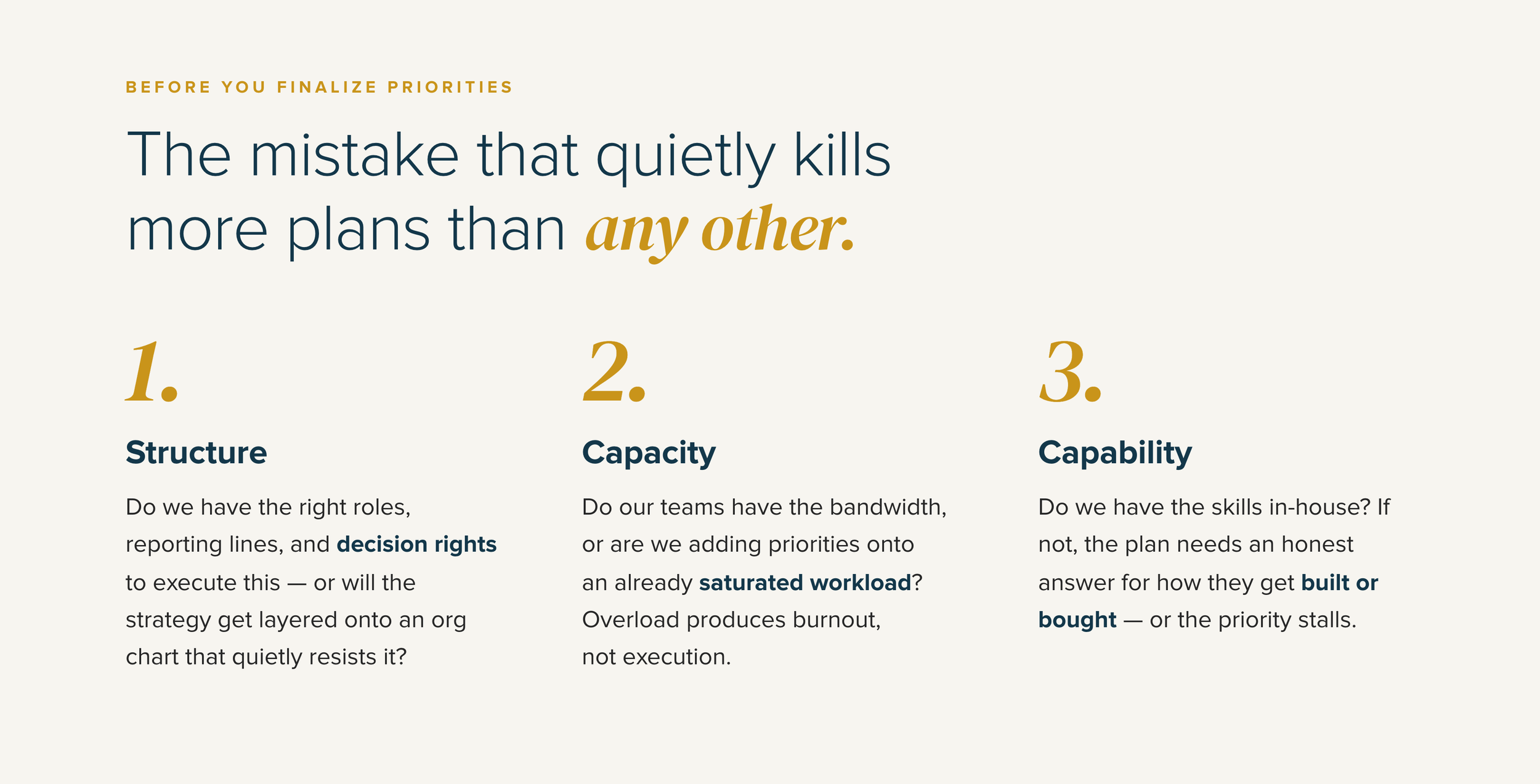
This is the mistake that quietly kills more strategic plans than any other. A leadership team sets bold direction, then hands the plan to an organization that is not structured, staffed, or resourced to deliver on it. The strategy is sound. The execution is impossible.
Strategy without capacity is theater. Before you finalize priorities, ask honest questions about three things.
Structure first. Do we have the right roles, reporting lines, and decision rights to execute this? Strategic plans often imply new ways of working: a new function, a new cross-functional collaboration, a new line of accountability. If those structural changes are not named and made, the strategy gets layered on top of an org chart that quietly resists it.
Capacity second. Do our teams have the bandwidth, or are we adding strategic priorities on top of an already saturated workload? Most organizations we work with are running at or above their healthy operating capacity before the new plan arrives. Adding three big strategic initiatives on top of full-time jobs does not produce execution. It produces burnout, half-finished initiatives, and quiet erosion of the operational work the organization depends on.
Capability third. Do we have the skills in-house? If the strategy requires data analytics, change management, digital marketing, or any other capability the team does not have today, the plan needs an honest answer for how those capabilities get built or bought. Otherwise, the priority that needed those skills will stall.
If the answers to these questions are uncomfortable, the plan needs to address them. Sometimes the boldest move in a strategic plan is restructuring before you scale. Sometimes it is sunsetting an existing program to free the capacity a new priority requires. These are strategic choices, not implementation details, and they belong in the plan itself.
5. No plan for execution
A strategy that is not built for execution is not a strategy. It is a wish.
Execution discipline starts during planning, not after. Every initiative in your plan should have three things attached to it from day one:
A measurable goal, so you know what success looks like and when you have reached it.
A named owner, so accountability lives with a person rather than a committee.
A clear integration with ongoing work, so the initiative does not get crowded out by the next quarterly fire drill.
That third one is the most overlooked. Strategic initiatives almost always lose to operational pressure when no one has thought through how the work fits into the cadence of the business. Who reprioritizes their workload to make room? Whose other responsibilities get reduced or reassigned? Which standing meetings get reshaped to give the initiative airtime? If your plan does not answer those questions, your strategic priorities will quietly migrate to the bottom of someone's to-do list.
You also need a cadence. Most plans fail because no one looks at them again until the offsite next year. The leadership teams that execute well build the rhythm into their operating model. Quarterly business reviews against the strategic priorities. Monthly check-ins on the initiatives behind them. A dashboard that surfaces the few metrics that tell you whether the strategy is working.
And you need a willingness to adapt. The environment will shift between when you write the plan and when you deliver it. Funders change priorities. Markets soften. Talent leaves. New opportunities appear. A plan that cannot absorb new information becomes obsolete in the same year it was written. Hold the direction. Adapt the path.
The pattern underneath
Look at these five mistakes together and a pattern emerges. Strategic planning fails when it is treated as a deliverable instead of a discipline. A binder, a presentation, a moment.
Done well, strategic planning is something else. It is how leadership listens, decides, aligns, and learns. It is how an organization moves together when the environment shifts. It is one of the few things that can break an organization out of the operational gravity that pulls every team toward the urgent and away from the important.
The leaders we admire most do not treat their strategic plan as the output of the process. They treat it as the starting point. The document gets written, then the real work begins: communicating it, integrating it, resourcing it, measuring it, defending it, and revising it as the world changes around them.
That is the difference between a plan that sits on a shelf and a plan that gets you moving.

David Naczycz is a Senior Associate Principal at Coraggio Group, where he helps leadership teams build the organizational structure and culture that let a strategy actually take hold. If your last plan is sitting in a shared drive somewhere, gathering digital dust, that is usually a sign the process needs rethinking, not the people.
Coraggio has guided more than 400 organizations through strategic planning built to last past the launch date. Book a conversation with David and find out what is getting in the way of yours.